


Buying Branded Merchandise from China vs a UK Supplier
What importing branded merchandise really costs beyond the unit price, how long it takes, who carries the legal responsibility, and what UK made means.


Related topics
View allThe unit price will usually be lower buying direct from an overseas factory. That is the easy part of the answer and it is also the part that misleads people, because the unit price is one line in a much longer bill.
The useful comparison is not China against the UK. Almost all promotional merchandise is manufactured overseas, including most of what a UK supplier sells you. The real question is whether you import it yourself or buy from somebody who imports it for you, because that decides who carries the cost, the time and the legal responsibility.
Here is what each side of that actually involves.
What the unit price leaves out
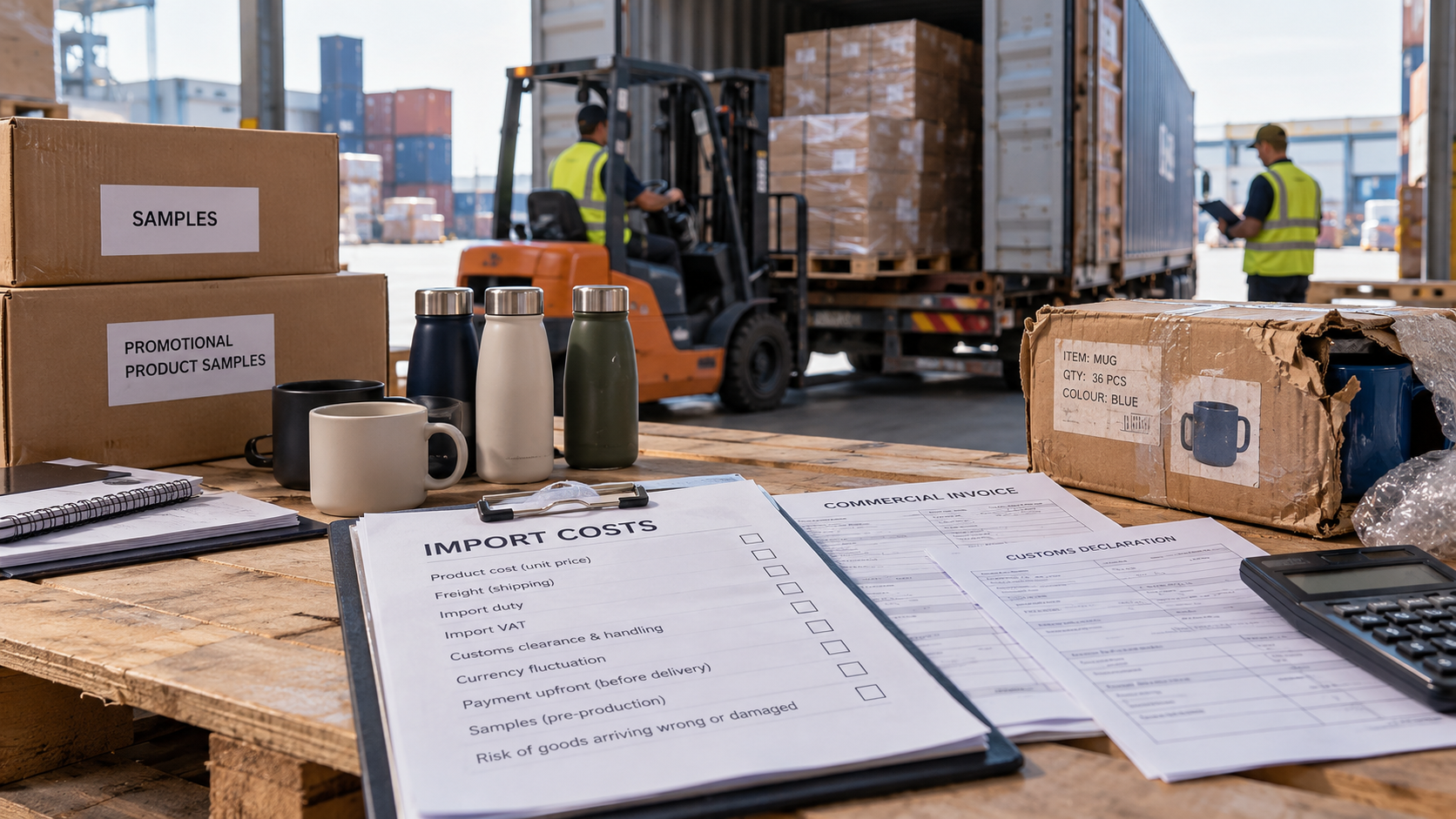
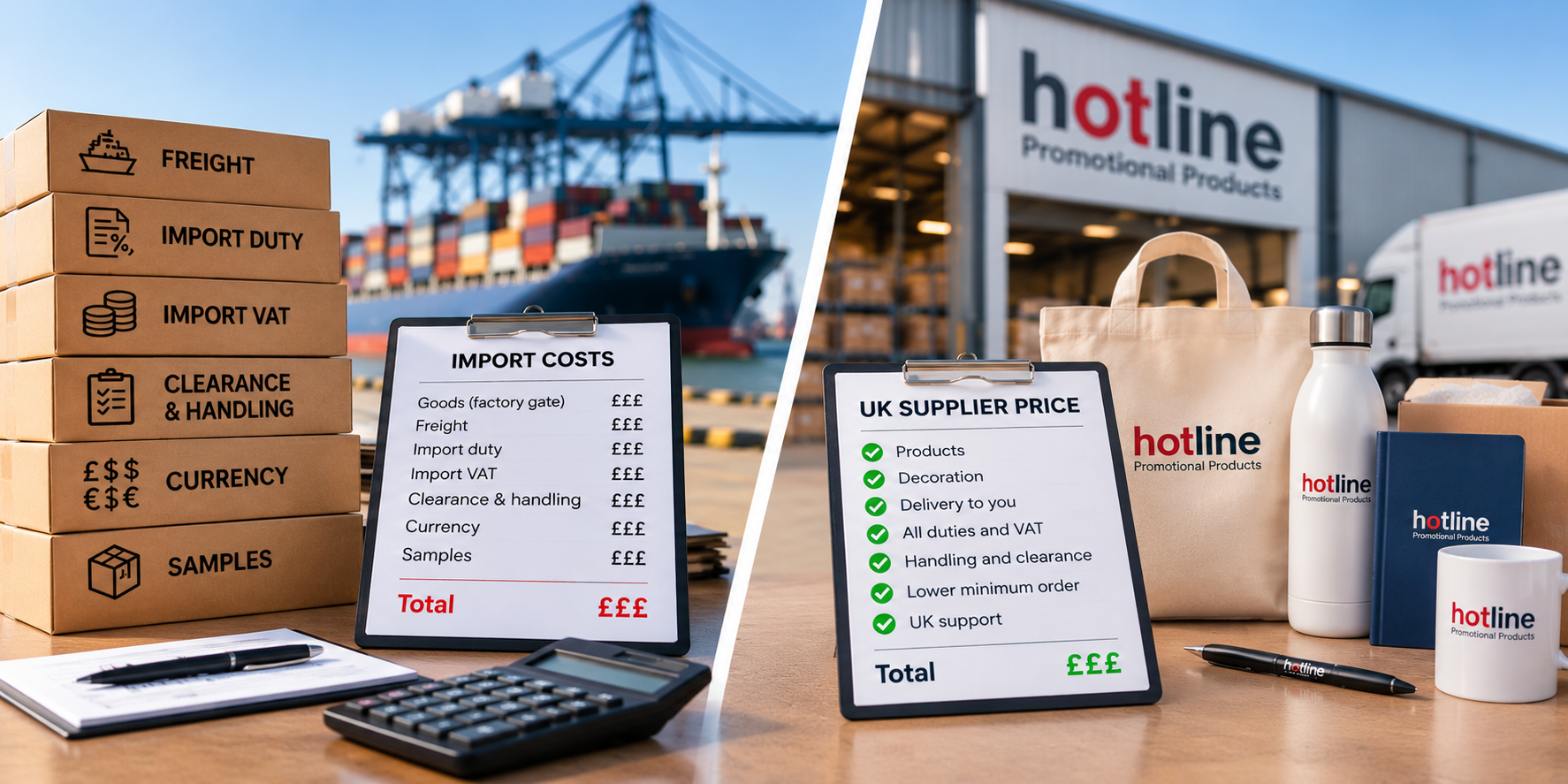
When a factory quotes you, the figure normally covers the goods at the factory gate and nothing else. Between that number and a box in your office sit the following.
Freight. Sea freight is priced by volume and weight rather than by unit, which means a small order carries almost the same shipping bill as a large one. This is the single biggest reason importing a modest quantity rarely works out cheaper. Air freight is faster and considerably more expensive, and it is usually what a delayed order ends up costing.
Import duty. Charged on the goods when they enter the UK, at a rate set by the product's classification. The rate varies widely by product type, so it has to be checked for what you are actually importing rather than assumed.
Import VAT. Charged at the standard rate on the value of the goods plus the freight plus the duty. If you are VAT registered this is normally recoverable, but it still has to be paid at the border, so it is a cash flow cost even when it is not a final one.
Clearance and handling. A customs broker to make the declaration, port handling charges, and delivery from the port to you. Each is small on its own and they add up.
Currency. Factory quotes are usually in dollars. The rate you got quoted is not the rate you pay, and on a long lead time the gap can be material.
Payment terms. Most factories take a deposit up front and the balance before the goods ship, which means your money leaves months before the goods arrive. A UK supplier normally invoices on delivery.
Samples. You will need them, they cost money, and each round costs weeks.
And the one nobody budgets for: what happens if the goods are wrong. If a shipment arrives off-colour, off-spec or damaged, you are holding it. Recourse against an overseas factory is theoretical for most buyers, and the practical options are to accept it, rework it here or absorb it.
Time, and the thing nobody warns you about
A realistic door-to-door timeline for a direct import runs to somewhere around ten to fourteen weeks: sampling and approval, then production, then several weeks at sea, then clearance and delivery. Air freight compresses the middle of that and costs a great deal more.
The thing to know before you plan anything is Chinese New Year. Factories close for a period around it, and the disruption is much wider than the closure itself: capacity is squeezed in the weeks before as everyone tries to ship ahead of it, and output takes further weeks to return to normal afterwards as workers come back. In practice it can take a two-month bite out of the calendar.
The date moves every year because it follows the lunar calendar, so check the date for the year you are planning in rather than assuming it is the same as last time. If your deadline sits anywhere near it, plan around it or buy domestically that quarter.
Hot Hassle Free Products
View All


The part that matters most: who is responsible
This is the section worth reading even if the numbers work.
When you import goods yourself, you become the importer. That is a legal position, not a descriptive one. It means the responsibilities that come with placing a product on the UK market sit with you rather than with the factory that made it: making sure the product meets the applicable UK requirements, that it is correctly marked, that the technical documentation exists, and that it is safe.
If something goes wrong with a product you imported, the enforcement conversation is with you.
That is manageable for a business with sourcing and compliance capability. It is a significant thing to take on by accident because a unit price looked good, and it matters far more on some products than others.
Where it matters most:
Anything electrical or containing a battery. Power banks and anything rechargeable carry transport testing and conformity requirements. Our guide to branded power banks and USB sticks covers what those documents are.
Anything intended for children. Toy safety requirements are stricter than general product requirements and the penalties for getting them wrong are higher.
Anything that touches food or drink. Mugs, bottles, flasks and printed confectionery all fall under food contact rules.
Anything worn against the skin, where restricted-substances requirements apply.
When you buy from a UK supplier, the supplier is the importer. They hold that position, they carry the responsibility, and they should be able to produce the paperwork on request. That is a large part of what the difference in unit price is buying, and it is invisible until the moment you need it.
This guide is not tax or legal advice. Import duty, VAT and product compliance obligations depend on what you are importing and on your own circumstances, so check the current position with HMRC or your own adviser before you commit.
When importing direct genuinely makes sense
There are real cases, and any supplier who tells you otherwise is selling.
| Direct import works when | Because |
|---|---|
| You are ordering very high volume of a single item | Freight and clearance costs spread across enough units to actually move the landed price |
| The product does not exist in any catalogue and has to be tooled | There is no alternative. Somebody has to commission a factory |
| You have a long lead time you control | The timeline stops being a risk and becomes a plan |
| You have in-house sourcing, QC and compliance capability | The responsibilities you are taking on are ones you can actually discharge |
| It is a repeating annual order | The setup, sampling and relationship cost amortises across years rather than falling on one order |
And when it does not: modest quantities, mixed orders across several products, anything with a deadline that cannot move, one-off orders, and anything electrical, edible or intended for children where you would be taking on responsibilities you are not set up to carry.
Why a UK supplier's price is closer than you expect
The gap between a factory quote and a UK supplier's price is usually smaller than the two headline numbers suggest, for two reasons.
A distributor buys pooled volume. They are placing orders across many customers, so they buy at volumes an individual buyer ordering a few hundred units cannot reach, and the landed price they achieve reflects that.
Their minimum is lower than a factory's. A factory sets up a production run, so its minimums are high by design. A distributor is decorating stock that is already here, which is why you can order in the hundreds rather than the thousands.
Put those together and the comparison a buyer should actually run is not the factory quote against the UK price. It is the fully landed cost of the import, including freight, duty, VAT, clearance, delivery and your own time, against the UK price with everything already in it. Our buying guide on budgets, quantities and lead times covers how promotional pricing works generally.
What "UK made" actually means on a promotional product
If provenance matters to you, whether for a sustainability policy, a social value requirement in a tender or a straightforward preference, there is a distinction worth knowing before you ask anyone for it.
Most promotional products sold in the UK are manufactured overseas. That is true across the category. What often happens here is the decoration: the printing, embroidery or engraving that puts your logo on the product.
So "printed in the UK", "decorated in the UK" and "branded in the UK" are all accurate descriptions of a product manufactured somewhere else. None of them means the product was made here.
Genuinely UK-manufactured promotional products do exist, and the range is narrower than the marketing suggests. If it matters for a tender or a policy, ask two specific questions rather than one general one:
- Where was the product itself manufactured?
- Where was the branding applied?
A supplier who can answer both separately is giving you something you can put in a submission. One who answers "we're a UK company" has answered a third question you did not ask.
What UK manufacture genuinely gets you: a much shorter supply chain and lower transport emissions, faster reordering, easier verification of working conditions, and in public sector procurement a contribution to social value criteria. What it costs: usually a higher unit price and a narrower choice of product.
For the related question of how to verify a sustainability claim rather than a provenance one, our guide to buying eco-friendly merchandise covers the certifications worth asking for.