
How to Buy Eco-Friendly Merchandise Without the Greenwashing
How to check green claims on merchandise: UK rules, which standard backs which claim, and what recycled, biodegradable...
How to check green claims on merchandise: UK rules, which standard backs which claim, and what recycled, biodegradable and plastic free really mean.
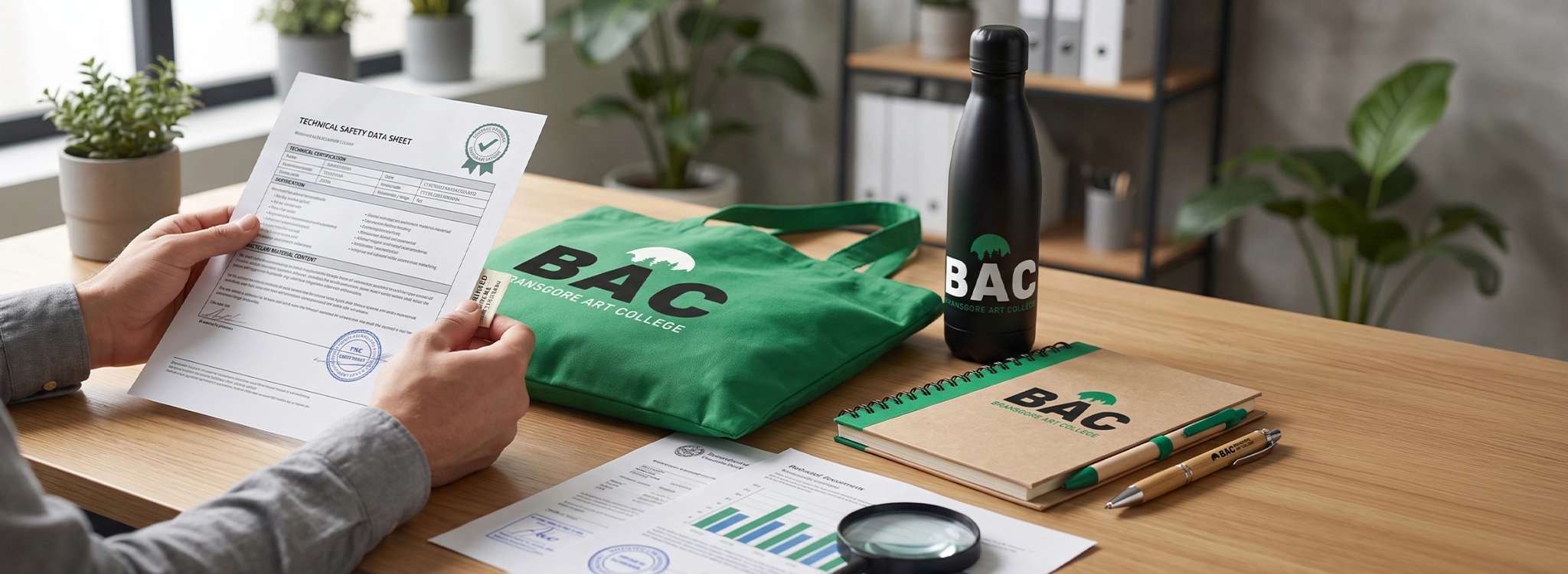

Check the claim rather than the label. Ask what the product is made of, how much of it is recycled or certified, which standard backs that up, and whether it'll be used long enough to justify making it. A product with answers to all four is a sound choice. A product that only says eco-friendly hasn't told you anything you can check.
This guide covers how green claims work in the UK, which standard backs which claim, the claims that most often mislead, and the questions to ask before you order.
Why greenwashing is common in promotional merchandise
Because supply chains are long and the words are easy to use.
A branded product can pass through several businesses in several countries before your logo goes on it. Vague claims survive that chain easily, and words like eco, green and sustainable have no fixed meaning, so they cost nothing to add.
The most common greenwashing patterns to watch for:
- Eco-friendly with no material named. A real claim says what the material is and who verified it.
- Recycled with no share stated. "Made with recycled materials" could mean a small fraction or nearly all of it.
- Biodegradable or compostable with no conditions. Most materials only break down under specific conditions.
- Carbon neutral with no method. Offsetting schemes vary a great deal in quality.
- One green feature on an ordinary product. A recycled lid on a plastic bottle is still mostly a plastic bottle.
A supplier who can't answer specific questions about what a product is made of, and how that's verified, is a supplier whose green claims deserve caution.
What do UK rules say about green claims?
That a claim has to be true, clear, complete and backed by evidence.
The Competition and Markets Authority's Green Claims Code sets out six principles. Claims must be truthful and accurate, clear and unambiguous, must not omit or hide important information, must make fair and meaningful comparisons, must consider the full life cycle of the product, and must be substantiated. The CMA says the code also applies, to a more limited extent, to businesses marketing to other businesses.
The Advertising Standards Authority takes the same approach to advertising. It treats broad terms like green and eco-friendly as claims about the whole product, from how it's made to how it's disposed of, so they need evidence to match.
For you as a buyer, the practical point is this. If you repeat a supplier's claim on your own merchandise, in your marketing or in a sustainability report, it becomes your claim. Checking it before you order is far easier than defending it afterwards.
As members of the BPMA, we're required to follow rulings by the ASA and the Committee of Advertising Practice, whose advertising rules include specific rules on environmental claims. Our article on what BPMA membership means explains the Code of Conduct we follow.
Correct as at September 2026. This is general information rather than legal advice.
Which standard backs which claim?
Each standard answers one question, so match the standard to the claim you need to make.
| Certification | What it verifies | Where you'll see it |
|---|---|---|
| GRS (Global Recycled Standard) | Recycled content, tracked through the supply chain, with social and chemical requirements on top | Recycled fabrics, plastics and metals |
| RCS (Recycled Claim Standard) | Recycled content traced through the supply chain, without the extra requirements of GRS | Recycled materials, most often textiles |
| FSC (Forest Stewardship Council) | Wood and paper from responsibly managed forests, recycled sources or a controlled mix | Notebooks, pencils, card and wooden items |
| GOTS (Global Organic Textile Standard) | Organic fibre, and how it's processed | Organic cotton bags and clothing |
| Fairtrade | How cotton farmers and workers were paid | Fairtrade cotton bags and clothing |
| OEKO-TEX Standard 100 | Testing for harmful substances, which makes it a safety standard rather than an environmental one | Textiles |
| B Corp | A company's overall social and environmental performance, rather than any product | Company websites and reports |
FSC uses three labels. FSC 100% means all the material comes from FSC certified forests, FSC Recycled means the product is made from recycled material, and FSC Mix means a mixture of certified forest, recycled and controlled material.
Our guide to what the labels mean on recycled and organic tote bags goes into the textile standards in more detail.
How do you check a green claim is genuine?
Find the standard on the product listing, then check it with the organisation that issues it.
Start with the product page. A genuine claim names a material and, where it matters, a standard, and says which part of the product it covers. Our eco range lists the materials on each product.
Then check the certificate. FSC certificates can be looked up in FSC's public certificate search, and our tote bag labels guide explains how to check GRS and GOTS certificates.
Finally, ask which parts of the product the claim covers. A recycled aluminium pen can still have a plastic refill, and a recycled cotton bag can have handles made from something else.
Are recycled promotional products actually better for the environment?
Often, but only when the product gets used.
Recycled material replaces new raw material, which is a real benefit. But a recycled product that's thrown away after one event still took energy, transport and packaging to make, so its recycled content hasn't achieved much. A recycled product that's used for years is the better outcome.
Two things are worth checking. The share of recycled content should be stated rather than implied. And recycled isn't the same as recyclable. Recycled describes what a product is made from, while recyclable describes what could happen to it afterwards, and only where the right facilities exist.
What do biodegradable and compostable really mean?
They only mean something useful when the claim says under what conditions.
Almost any material breaks down eventually, so a biodegradable claim is only useful if it explains how and where. The ASA's guidance on biodegradable and compostable claims expects advertisers to hold evidence for them and to make clear what a claim means for disposal.
Compostable has an extra catch. A product certified for industrial composting needs the conditions of a commercial facility, which a garden compost heap doesn't provide. If a product says compostable, check whether it means at home or industrially.
What does carbon neutral mean on a promotional product?
Usually that emissions have been offset rather than avoided.
Offsetting means paying for emissions to be reduced or removed somewhere else, often through carbon credits, and the quality of those schemes varies widely. Before relying on a carbon neutral claim, ask what part of the product's life it covers, whether emissions were reduced first or only offset, and which scheme was used and who verified it.
What about ocean plastic and bamboo?
Both are real, and both are easy to overstate.
Ocean plastic. Ocean bound plastic is plastic waste collected on land near coastlines, in places without proper waste collection, before it reaches the sea. Collecting it is worthwhile, but it's a different claim from plastic recovered from the ocean itself, so check which one a product means and whether a certification scheme backs it.
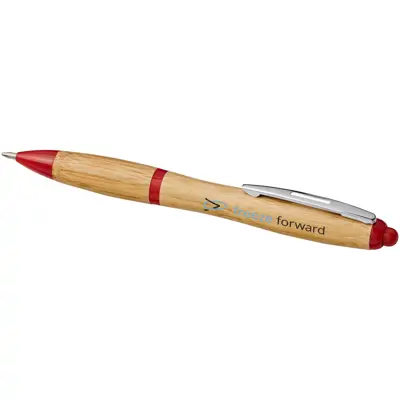
Bamboo. Bamboo grows quickly, and a pen barrel or desk item made from solid bamboo is a simple natural material. Bamboo fabric is different, because it's usually processed into viscose, and that processing is where the environmental case gets weaker. Our bamboo pens are the solid kind.
What does plastic free mean on merchandise?
That every part of the product is plastic free, including the parts you don't notice first.
A plastic free claim covers the refill, the trims, any coating or lining, and the packaging, as well as the main material. A card pen with a plastic refill isn't plastic free, and neither is a jute bag with a laminated lining, however natural it looks.
Products where every part can be plastic free include unlaminated cotton and jute bags, solid wood and bamboo items, notebooks with paper covers, and stainless steel bottles with plastic free lids. Check each product's listing for its materials rather than judging by the look of it.
How do you run a trade show giveaway without single use plastic?
Give away something reusable, and check how it's packed.
A steel or glass bottle people refill at the water station, a cotton tote, a notebook or a pen they'll keep all do the job without anything designed to be thrown away. Individually bagged items add plastic back into an otherwise plastic free giveaway, so check how products are packed as well as what they're made of.
Two habits help more than any material choice. Order the quantity you'll actually hand out, because stock that's never used is wasted however it was made. And leave the year off the design, so anything left over can be used at your next event. Our guide to choosing promotional products for an event covers giving away things people keep.
What should you ask before you order?
Five questions cover most claims.
- What is it made of, and what share is recycled, organic or certified?
- Which standard backs the claim, and can you show the certificate?
- Which parts of the product does the claim cover?
- Where is it made?
- What should happen to it at the end of its life?
Then one question for yourself: will people use it? A product that gets used for years does more good than a greener one that goes straight in a drawer.