
Branded Water Bottles, Mugs and Travel Flasks: How to Choose
How to choose between branded mugs, water bottles and travel flasks: materials, insulation, logos on curved surfaces...
How to choose between branded mugs, water bottles and travel flasks: materials, insulation, logos on curved surfaces and dishwasher durability.

Related topics
View allThree questions settle most drinkware decisions: where the item will actually be used, whether it needs to keep a drink hot or cold, and how it will be cleaned. Answer those and the choice between a mug, a bottle and a flask usually makes itself.
This guide covers each of the three products, how a logo gets onto a curved surface, and the two things that most often go wrong after delivery.
Start with where it will be used
On a desk. A ceramic mug. It gets used daily, it sits in view of everyone who walks past, and it costs less per unit than anything else here.
On a commute or in a car. A travel mug or a flask. The lid is the whole product, and a mug that leaks in a bag gets thrown away once.
At the gym, on site or outdoors. A water bottle. Look for a sports lid, a wide enough neck to get ice into, and a material that survives being dropped.
At an event. Usually a bottle, because people carry it around for the rest of the day and take it home. A mug at an event is something to carry carefully for six hours, which is why they end up left on the stand.
If you are buying for a mixed group and cannot pick, a double walled stainless steel bottle is the item that annoys the fewest people. It works hot and cold, it survives a bag, and it does not look cheap.
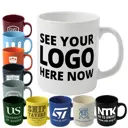
Promotional Mugs come in a variety of styles
View All


Branded mugs
Ceramic is the standard, and the differences that matter are the finish and the print.
Earthenware: is the everyday mug: thicker walls, more colour options, lower cost. Stoneware: is denser and heavier, and feels more substantial in the hand. Bone china: is the thin, light, premium end, and it prints beautifully.
The branding options split into two. A wrap-around print covers the full outer surface and suits photographic artwork or a design that runs round the mug. A screen or pad print puts a logo on one or both sides and is the more common choice for a straightforward brand mark.
Two practical points that catch people out.
The handle limits the print area. A mug has two usable panels, one either side of the handle, and a design that runs across the handle will break. If your logo is wide, check how it sits on the panel before you approve it.
Left-handed and right-handed placement. If the logo goes on one side only, it faces the room from one side and faces the drinker from the other. Most buyers want it facing outwards for the person opposite. Say which you want, or ask for both sides.
Browse the range on our branded mugs page.
Branded water bottles The material decision comes first, because everything else follows from it.
| Matrial | Feels like | Best for | Watch for |
|---|---|---|---|
| Plastic | Light, low cost, lots of colours | Events, mass giveaways, sports | Check it is BPA free. Cheaper plastics can hold a smell |
| Recycled plastic (rPET) | Same as plastic | Events where sustainability is in the brief | Ask what the recycled percentage is and whether it is certified |
| Aluminium | Light metal, single walled | Mid-range giveaways, outdoor events | Single walled, so it does not insulate and can sweat with cold drinks |
| Stainless steel, single wall | Solid, durable | Everyday use on a budget | Same insulation limits as aluminium |
| Stainless steel, double wall | Heavier, premium | Staff gifts, client gifts, anything kept for years | The most expensive option here, and the one people keep |
Double walled means vacuum insulated. Two layers of steel with the air removed between them, so heat cannot travel across the gap. That is what keeps a cold drink cold in a warm room and stops the outside of the bottle sweating. A single walled bottle cannot do either, whatever it costs.
The other decision is the lid. A sports or push-pull lid is quicker to drink from and easier to use one-handed. A screw cap seals better and is the safer choice if the bottle lives in a bag with a laptop.
Each bottle's specification, including its capacity and its insulation performance where it has any, is on its own product page. Browse the range on our metal sports bottles page.
Branded travel mugs and flasks
If you want a logo on a flask or a travel mug for a team, this is the section that matters, because the choice is mostly about the lid and the branding surface rather than about the brand name on the outside.
A travel mug is for drinking from. It has a lid you drink through, it fits a car cup holder, and it is designed to be opened and closed repeatedly on a commute.
A flask is for carrying. It has a sealed screw top, it holds more, and it is designed to stay shut until you want a drink. Many come with a cup that doubles as the lid.
Both are vacuum insulated, so both keep a drink hot or cold. The retention figure varies by product and is shown on the product page.
Leak-proof and spill-proof are not the same thing, and this is the single most useful thing to know before ordering. A spill-proof lid stops a drink sloshing out when the item is upright and moving. A leak-proof lid holds when the item is on its side in a bag. If these are going to people who commute with a laptop, check which one you are buying, because the difference only shows up once.
On branding, stainless steel takes laser engraving, which removes the coating to reveal the steel underneath. It cannot fade, chip or wash off, because there is no ink involved. It is a single colour by definition, so a multi-colour logo needs printing instead. Our guide to screen printing, embroidery and engraving covers the methods in more depth.
Browse the range on our travel and thermal mugs page.
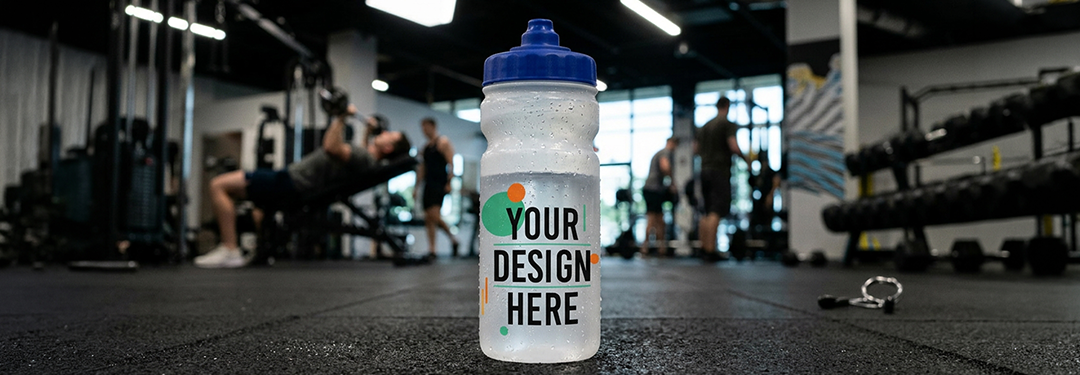
Promotional Bottles
View All


Getting a logo onto a curved surface
Drinkware curves, and a print does not. That constraint drives most of what a proof comes back looking like.
The print area is narrower than the product looks
The usable panel is the part of the surface flat enough to take an even application, which is always less than the full circumference. Wide logos get reduced to fit the panel height rather than the product width.
Simple marks survive the curve, fine detail does not
A logo with hairlines or small text will lose the detail at the edges of the panel where the surface falls away.
A wrap-around print solves it, on the products that offer it
The design is applied to the whole surface rather than to a panel, which is the route for artwork that will not sit in a panel.
You will get a free Visual Proof within 20 minutes showing your logo on the actual product, and you can change it as many times as you need before you approve it. Curved products are the ones most worth spending a minute on at that stage.
The two things that go wrong after delivery
Printed logos fading in a dishwasher
This is the most common drinkware complaint and it is avoidable. A print on a mug or a bottle has to be properly fired or cured to survive repeated hot washes and detergent. One that is not will dull, then patch, then lift. If these are going to people who will put them through a dishwasher every day, which is most staff mugs, check what the product page says about dishwasher suitability before you order rather than after. Laser engraving on stainless steel sidesteps the problem entirely, because there is nothing sitting on the surface to come off.
Ordering a single walled bottle when the use case needed a double
A single walled steel bottle looks almost identical to a vacuum insulated one in a photograph and costs considerably less. It also sweats with a cold drink and does nothing for a hot one. If anybody is going to put coffee in it, it needs to be double walled.
Minimums, cost and ordering
Minimums are set per product rather than as a blanket policy, and drinkware sits at the lower end of the range. If you want a small run, the number on the product page is the one that applies, and if it is higher than you need there is often a similar product with a lower one. Ask us rather than scaling the order up to reach a threshold.
On cost, the drivers are the material, whether the product is insulated, and the decoration method. Insulation is the biggest single step in price, because a vacuum flask is two products bonded together. Decoration then moves it: a one-colour pad print costs less than a wrap-around print or an engraving.
The per-unit price falls as the quantity rises, because the setup for a decoration run costs much the same at 50 units as at 500. Every product page shows its price at the quantity you enter, its minimum order and its guaranteed delivery date, before you speak to anyone. If you are putting drinkware into a wider order, our guide to what to include in a new starter welcome kit covers the rest of the kit, and our buying guide on budgets, quantities and lead times covers ordering across every category.