

Custom Printed Notebooks for Clients: Options, Branding and Costs
How to choose a branded notebook: size and binding, cover materials, debossing against foil, paper weight, and what...
How to choose a branded notebook: size and binding, cover materials, debossing against foil, paper weight, and what makes it a client gift.
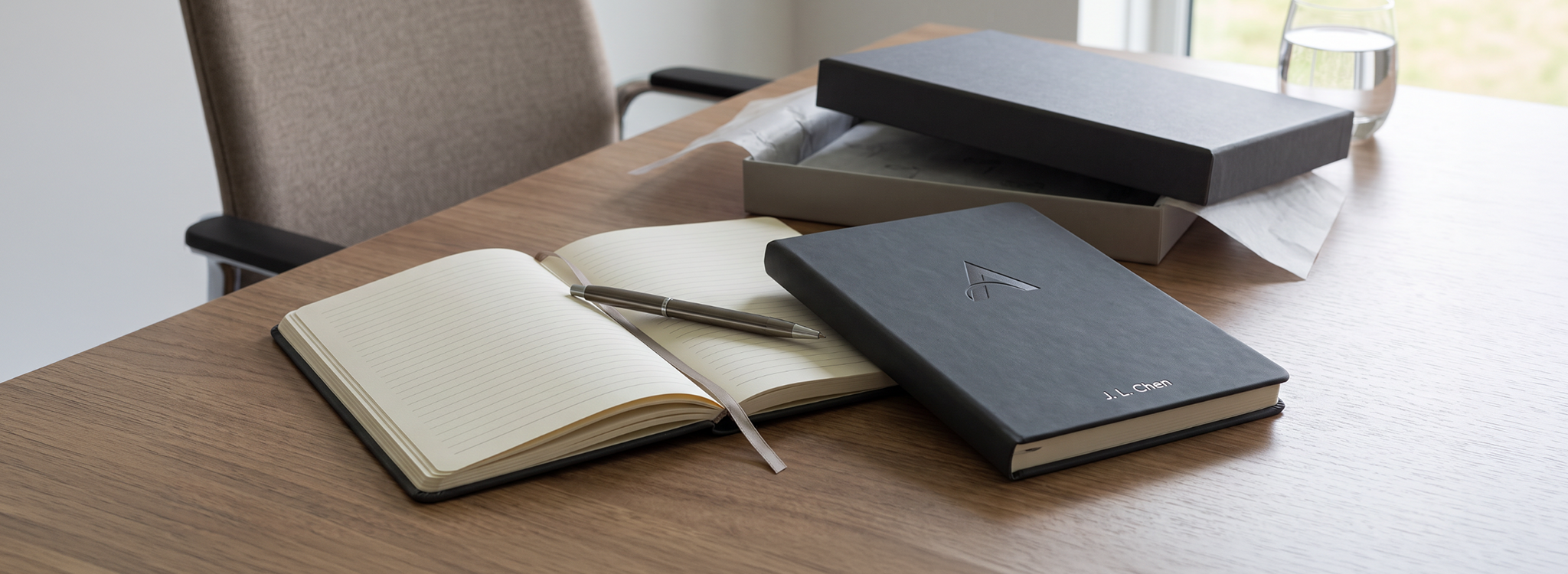

A branded notebook is one of the few promotional products people genuinely keep, which is why it turns up in conference bags, welcome kits and client gifts alike. It is also a product where the specification does most of the work, and where the difference between a notebook somebody uses for a year and one they leave in a drawer comes down to four or five decisions made at the order stage.
This guide covers those decisions: the format, the cover, the branding method, the paper, and what separates a notebook you give a client from one you hand out at a stand.
Start with the format
Size
A5 is the standard and the safest choice, large enough to write properly in and small enough to carry. A4 suits training, workshops and anything involving printed handouts. A6 and pocket sizes are for jotting rather than for note taking, and they suit giveaways more than gifts.
Binding
This is the decision people skip and notice later.
- Casebound or sewn notebooks have the pages sewn into the spine. They are the most durable and the most premium, and a good one will lie flat when opened, which matters more than it sounds when somebody is writing in a meeting.
- Wiro or spiral binding folds fully back on itself and lies completely flat, which is why it suits workshops and training. It is less formal and the wire can catch in a bag.
- Perfect binding glues the pages to the spine. It looks clean and is the least durable of the three under heavy use.
Page ruling
Lined is the default and the safest for a mixed audience. Dotted has become the standard for planning and sketching. Plain suits designers and anyone drawing. Squared suits technical work. If you are ordering for a client base you do not know, lined or dotted.
Extras that mark it as a gift rather than a giveaway
An elastic closure, a ribbon page marker, a pen loop and an expandable pocket inside the back cover. Individually they cost little. Together they change what the product feels like in the hand.
Choose the cover, because it decides the branding
The cover material is the single most important choice on a branded notebook, because it sets both the perceived value and which branding methods are physically possible.
| Cover | Feels like | Branding it takes | Best for |
|---|---|---|---|
| Printed card | Light, everyday | Full colour print across the whole cover | Events, high volume, full-colour artwork |
| Kraft or recycled board | Natural, unbleached | Screen print, light deboss | Sustainability-led campaigns and events |
| Soft-touch PU | Smooth, slightly padded, premium | Deboss, foil, screen print | Client gifts, senior onboarding, the default premium choice |
| Hard cover, cloth-bound | Solid, book-like | Screen print, pad print | Gifting where the notebook is the whole present |
| Wood or cork | Textured, natural | Screen print, digital print | Sustainability-led gifting with a distinctive finish |
The short version: if you want a debossed logo, you need a cover that will hold an impression, which means PU or a similar flexible material. A rigid printed board will not take a deboss cleanly, and asking for one on the wrong cover is the most common reason a notebook proof comes back looking wrong.
Branding methods, and what the four words actually mean
These get used interchangeably and they mean different things.
| Method | What it does | Colour | Best on |
|---|---|---|---|
| Debossing | Presses the design into the cover, leaving a recessed impression | None. The finish is the shadow in the material | PU, leather-look, soft covers |
| Embossing | Raise the design above the cover surface | None | PU and cloth covers |
| Foil blocking | Presses coloured foil into the cover, usually gold, silver, copper or a matched colour | One foil colour | PU, cloth, kraft, card |
| Deboss with foil | Both at once, so the design is recessed and filled with foil | One foil colour | PU and cloth. The most premium finish available |
| Screen or pad print | Applies ink to the surface | One or more spot colours, priced per colour | Card, kraft, cloth |
| Full colour print | Digital print across the cover | Unlimited | Printed card covers |
| Laser engraving | Removes a surface layer to reveal the material beneath | None | Wood and cork covers |
Two practical points. Deboss and emboss are colourless, so on a dark cover the logo reads as a subtle texture rather than as a mark you can see across a room. That is usually the intention on a client gift and usually the wrong choice for an event where you want the brand visible. Foil on a dark cover is the combination that gives you both, which is why deboss-with-foil on a dark PU cover is the standard premium corporate notebook.
Our guide to screen printing, embroidery and engraving covers the methods across every product category.
Paper weight, and why ink shows through
The most common complaint about a branded notebook is that the writing shows through to the next page, and it is entirely predictable before you order.
Paper weight is given in gsm. Lighter paper is cheaper, and it is fine for a pencil or a ballpoint. It is not fine for a fountain pen, a gel pen or a marker, all of which will ghost through to the reverse and often through to the next sheet. Heavier paper stops that.
If you are ordering a notebook as a client gift, assume the recipient owns a decent pen. It is one of the few places where a small step up in specification is immediately noticeable to the person receiving it. The paper weight for each notebook is on its product page.
Page count works the other way round. More pages means a thicker, heavier notebook that costs more to make and more to ship, and beyond a point nobody fills it. For an event or a welcome kit, a moderate page count in good paper beats a thick one in thin paper.
What makes it a client gift rather than a giveaway
Three things, and none of them is the notebook itself.
The finish. A debossed or foiled logo on a soft-touch cover reads as considered. A full-colour logo printed large across a card cover reads as marketing. Both are right in their place, and the place for the second one is not a client's desk.
The presentation. A notebook in a branded gift box, or paired with a good pen, is a present. The same notebook in a mailing bag is a delivery. If the notebook is doing the whole job of the gift, the packaging is part of the product rather than an extra.
The personalisation. A client's own name on the cover alongside your logo is the thing that stops a gift being generic. It costs more per unit and it takes longer, and for a list of key accounts it is usually worth both.
If you are building a wider gift rather than sending a notebook on its own, our premium corporate gifts range carries the products that pair with one.
Quantities, lead times and the made-to-order question
Notebooks come in two broad models and they behave differently.
A stocked notebook is branded to your artwork and shipped. The format, cover and paper are already decided, you choose from what exists, and the only production step is the branding. That keeps minimums lower and lead times shorter.
A made-to-order notebook is manufactured to your specification, which can include a custom size, custom printed pages, a custom cover material or bound-in content. It gives you things a stocked range cannot, and it costs more and takes considerably longer, because the notebook has to be made before it can be branded.
Neither is better. If you need a specific format that does not exist, or printed content inside, made-to-order is the only route. If you need a good branded notebook in a normal size within a few weeks, the stocked route will be faster and cheaper every time. Our guide to choosing between supplier types covers that decision properly.
On minimums, they are set per product rather than as a blanket policy, and the number on the product page is the one that applies. If it is higher than you need, ask us, because there is often a comparable notebook with a lower one.
On cost, the drivers are the cover material, the binding, the paper weight, the page count and the branding method. Deboss with foil costs more than a single-colour print, and a sewn cloth cover costs more than printed card. Every product page shows its price at the quantity you enter, its minimum order and its guaranteed delivery date, before you speak to anyone. To see what is available, browse our branded notebooks.