
Staff Want Company Hoodies: How to Organise It
How to organise a company hoodie order: collecting sizes, embroidery or print, how minimums work on clothing and a...
How to organise a company hoodie order: collecting sizes, embroidery or print, how minimums work on clothing and a realistic timeline.

Related topics
View allStart by settling three things: how many you need, who is paying and what sizes people actually want. Everything else follows from those answers, and the sizes are the part that will hold you up.
Staff asking for hoodies is a good problem to have. It means people want to wear your logo, which is not true of most branded clothing. Here is the order of operations that keeps it simple.
First, work out who is paying
There are three usual arrangements and they change how you order.
- The company pays for everyone. Simplest. You order against a headcount and a size list.
- The company pays for a standard hoodie and staff top up. Workable, but pick one garment and one branding position, or you will be managing several orders at once.
- Staff pay for their own. Set one deadline for both the money and the sizes, and order what you have on the deadline. Collecting two things from busy people at two different times is where these orders stall.
One thing worth a five-minute conversation with whoever handles your payroll: branded clothing given to staff can be treated differently for tax depending on whether it counts as workwear or as a gift. It is better to ask before you commit the budget than after.
Collect the sizes properly, because this is what causes the delay
Production is rarely the reason a hoodie order takes three weeks. Size collection is.
- Use a private form. A group chat or a sheet on the wall means people declare their size to their colleagues. Ask privately and you will get accurate answers faster.
- Ask for size and fit in the same question. Plenty of garments come in a unisex cut and a women's cut and they fit differently. Let people pick rather than assigning.
- Put the sizes above and below the standard run on the form. If your form stops at XL, anyone who needs bigger has to come and ask you specially. Include the full range the garment offers and nobody has to.
- Give a deadline and say what happens after it. "Anything not in by Friday goes on the next order" is enough.
- Order a small buffer in the most common sizes if the budget allows. Someone always joins, and someone always gets their size wrong.
Promotional Hoodies
View All


Choose the garment before you choose the branding
Three things matter more than the rest.
Weight
Fabric weight is given in gsm on the product page. Heavier fabric feels more substantial and costs more. It is the difference people notice first when they pick the hoodie up.
Fit and size range
Check what the garment actually offers before you settle on it. If you want to give people a choice of cut, check that both are available in the same style and colour, otherwise you are running two orders.
Colour
Most teams pick something dark, which hides marks and suits most logos. It also changes the branding decision, which is the next section.
Every clothing product page shows stock as a real number broken down by size, rather than a tick or a traffic light. It is worth looking at that before you fall in love with a garment, because it tells you whether the size run you need is actually there.
Embroidery or print
For hoodies, embroidery most of the time. Here is the comparison.
| Label | Embroidery | |
|---|---|---|
| How it works | Stitched into the fabric with thread | Applied on top of the fabric |
| Best for | Left chest logos, simple shapes, garments worn for years | Detailed or multi-colour logos, larger designs, backs |
| On dark fabric | Thread colour is chosen, so it stays true | Light colours need an underbase, which thickens the print |
| Durability | Does not crack or fade | Can crack or fade with washing over time |
| What drives the cost | Stitch count, so a detailed logo costs more than a simple one | Number of colours and the size of the print |
| Feel | Raised and textured | Flat, and softer across a large area |
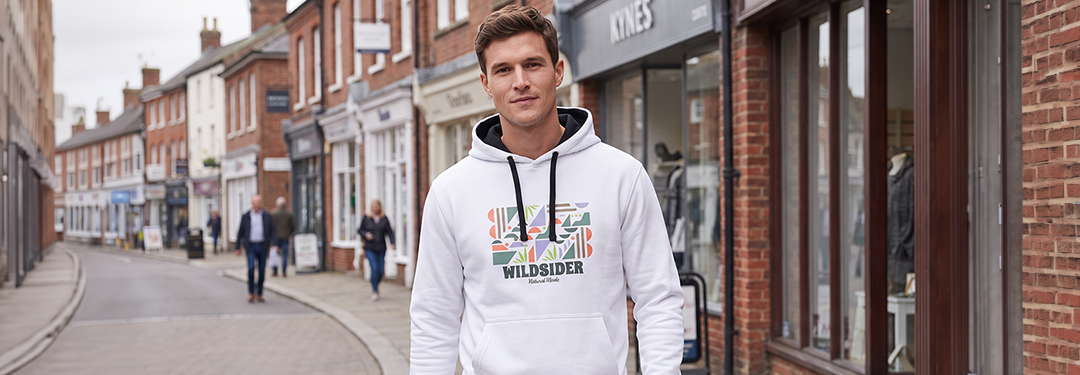
If your logo has fine detail or a white element and the hoodie is dark, ask to see it on the actual garment colour before you approve anything. Fine lines that look right on a website disappear at chest size, and that is easier to fix at the proof stage than after 40 hoodies have been stitched.
You will get a free Visual Proof within 20 minutes showing your logo on the garment colour you have chosen, and you can change it as many times as you need before you approve it. Our guide to screen printing, embroidery and engraving covers the methods in more detail.
How the minimum works, because this is what catches people out
Minimums on clothing generally apply per style and per colour rather than per order. Ten hoodies split across two colours can be two separate minimums rather than one. The same question applies if you are offering two fits: check whether they count as one line or two before you promise anyone a choice.
If you are ordering for a small team and want to keep it simple, the way to do it is one garment, one colour, one branding position, and let the size split do the variety.
Minimums are set per product rather than as a blanket policy, and clothing sits at the lower end of the range. The number on the product page is the one that applies. If it is higher than you need, ask us anyway, because there is often a similar garment with a lower threshold.
What it costs, and what moves the number
Two costs sit in every clothing order: the garment and the branding.
The garment price falls as the quantity rises, because the setup for a branding run costs much the same whether you are doing 10 or 500. Spreading that setup across more units is the whole reason the per-unit price drops.
The branding cost moves for different reasons depending on the method. Embroidery is priced on stitch count, so detail costs money. Screen print is priced per colour. And extra positions are extra applications, so a left chest logo plus a back print is two, not one.
Every product page shows its price at the quantity you enter, its minimum order and its guaranteed delivery date, before you speak to anyone. Once you have a price from us it is held for 14 days, which is usually long enough to collect sizes and get the spend signed off without the number moving underneath you.
A realistic sequence
Agree the budget and who is paying. Nothing else can start until this is settled.
Pick the garment, the colour and the branding method, then send us your logo and check the proof on that garment colour.
Collect sizes. Allow a week, and longer if people are on shift patterns or annual leave. This is the step that sets your timeline.
Place the order against the size list, including any buffer.
Production and delivery. You will see a guaranteed delivery date before you order.
If you have a date to hit, use the Fastest Delivery filter on the left hand side, and this will give you the garments which can be delivered in the shortest lead time.
The mistakes worth avoiding
Ordering before you have the sizes. You will end up with a pile of larges and three people without a hoodie.
Ordering equal quantities across the size run. Real size distributions are never flat. Use the list you collected.
Offering one fit when the garment comes in two.
Using a logo designed for a website at chest size. Fine detail does not survive the reduction, in thread or in ink.
Leaving a size off the form because only one person needs it.
To see what is available, browse our branded hoodies and sweats. If you are putting clothing into a wider order, our guide to what to include in a new starter welcome kit covers the rest of the kit, and our buying guide on budgets, quantities and lead times covers ordering generally.