

Printed Lanyards, Wristbands and Badges: An Event Buying Guide
How to choose event identification: lanyard materials, why a safety breakaway matters, which wristband suits which...
How to choose event identification: lanyard materials, why a safety breakaway matters, which wristband suits which event, and badge fixings.
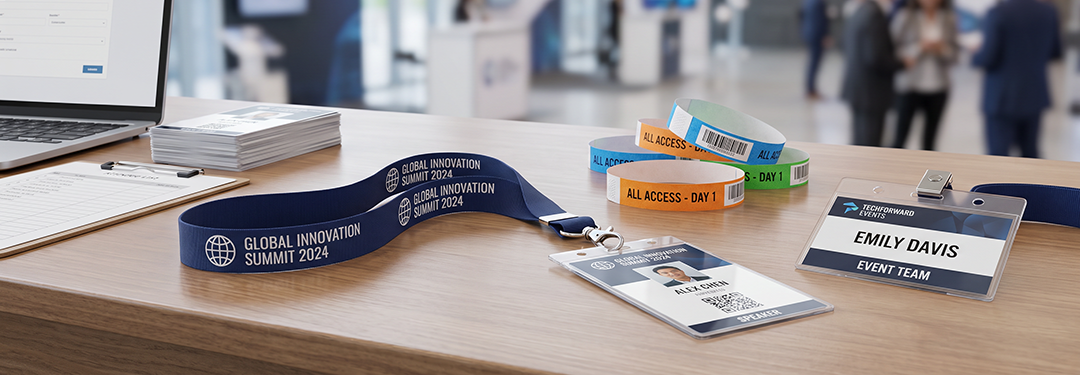

Event identification is three products doing three jobs. A lanyard carries a pass and identifies someone all day. A wristband controls access or marks that somebody has paid, entered or participated. A badge carries a name and a role.
Most events need at least two of the three, and the mistakes tend to be the same ones every time: the wrong fixing, the wrong wristband for the number of days, and a print that means the whole lot gets thrown away afterwards.
Popular conference lanyards and pass holders
View All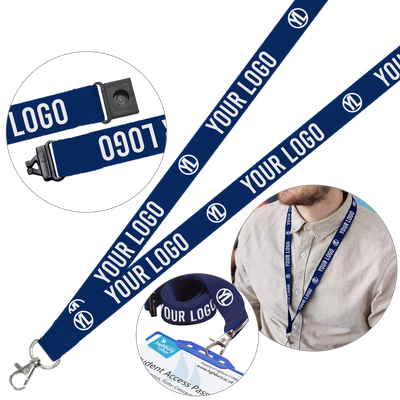
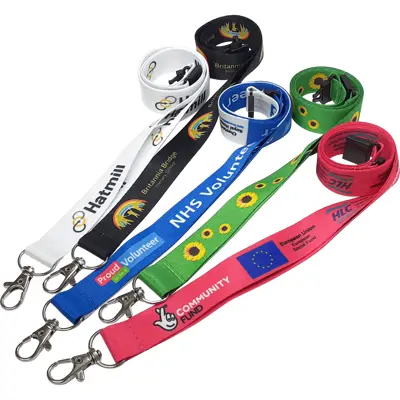
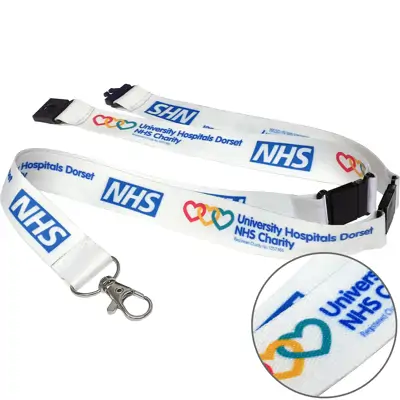
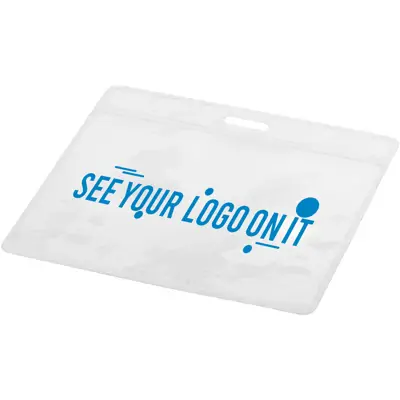
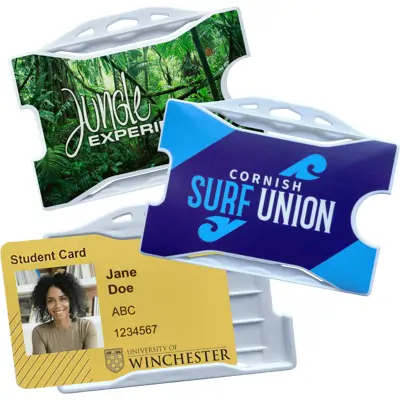
Printed lanyards
Choosing the material
Polyester is the standard. It takes print well, it is durable and it is the most cost-effective option at volume.
Woven lanyards have the text woven into the fabric rather than printed on top, which cannot rub off and reads as the more premium option. Simple text and shapes only, since the weave cannot hold fine detail.
Satin or ribbon is softer and smoother, suits a lighter or more formal look, and shows wear faster than polyester.
Tubular is a rounded cord, the cheapest option, and best where the lanyard is functional rather than a branding surface.
Recycled polyester, bamboo and cotton are the sustainable options, and the material question is covered properly in the section below on ordering once.
Print method
Screen printing applies solid colours and is the most economical route for a simple logo in one or two colours.
Full-colour print, usually dye sublimation, carries gradients, photographic artwork and complex marks, and the dye goes into the fibres rather than sitting on the surface.
Weaving puts the text into the fabric itself. It costs more, takes longer, and lasts longest.
Wider lanyards give you more print area and cost more. If your logo is wide rather than tall, that extra width is usually the difference between a legible mark and a squashed one.
The fixing, and the part that matters most
The attachment at the bottom holds the pass. A swivel or trigger hook is the most common and lets the card rotate to face the right way. A bulldog clip attaches to a card or to clothing directly. A split ring suits keys as well as passes. A double-ended lanyard clips at both sides and stops a pass swinging.
The part worth deciding deliberately is the safety breakaway. This is a clasp at the back of the neck that comes apart if the lanyard is pulled or caught. It is the reason a lanyard can be worn safely near machinery, equipment, vehicles or children, and many organisations require one as standard. Schools, hospitals and manufacturing sites usually will not accept a lanyard without one.
If you are ordering lanyards for a workplace rather than a one-day conference, ask for a breakaway and check it is included rather than assuming. It is a small cost and it is the single most important specification on the product.
Browse the range on our printed lanyards page.
Printed wristbands
The decision here is what the wristband is for, because the three uses need three different products.
For access control over one day: Tyvek. A paper-like material that is tough, water resistant and cannot be removed and reapplied once the adhesive is set. It is the cheapest option and the fastest to produce, which makes it the standard choice for festivals, one-day events and venue entry.
For access control over several days: vinyl or plastic. A snap or slot closure holds up to being worn continuously, through showers and sleep, for a week. Look for a one-time locking clasp, which is what makes the band tamper evident: once it is on, it cannot be taken off and passed to somebody else without visibly breaking.
For a keepsake or an awareness campaign: silicone. These are worn long after the event, which makes them the right choice for charity campaigns, memberships and anything you want people to keep. The message can be debossed into the surface, debossed and colour filled, embossed above it, or printed on top. Debossed and colour filled lasts the longest, because the ink sits in a recess rather than on the surface.
For festival-style events: fabric. A woven band with a sliding bead lock, which holds tight, survives weeks of wear and looks the part.
If your event needs auditing, ask about sequential numbering or barcoding, which lets you count and check entries rather than just look at a wrist.
Browse the range on our printed wristbands page.
Printed badges
Button badges are the low-cost, high-volume option for campaigns and giveaways, printed in full colour and pinned on.
Name badges come in two forms and the difference is a cost decision rather than a look. A printed badge carries the name permanently and is right for a one-off event. A reusable holder with a printed insert costs more up front and less across a year, because the holder gets used again for every event and only the insert changes. If you run more than two events a year, the reusable version usually wins.
Enamel pins are the premium end. Soft enamel leaves the colour recessed below the metal lines, giving a textured finish. Hard enamel is polished flat and feels more like jewellery. Both last indefinitely.
On the fixing: a standard pin makes a hole in whatever it is attached to, which matters when staff are wearing their own clothes. A magnetic fixing avoids that entirely and is worth the small extra cost for anything worn on good clothing. One caution, and it is worth passing on to whoever is handing them out: manufacturers advise that magnetic badges should not be worn by anyone with a pacemaker or an implanted defibrillator, so a pin version should be available alongside them.
Browse the range on our printed badges page.
Order once, use it twice
The most useful thing to know about event identification is that most of it does not need to be single use, and the thing that makes it single use is almost always the print.
A lanyard printed with your organisation's name gets worn at every event you run. The same lanyard with "Annual Conference 2026" on it goes in a bin on the Friday. The material is identical. The only difference is what you asked us to print.
So unless the date is doing a job, leave it off. Put the organisation on the lanyard and the event on the pass insert, which is the part that is meant to change. You will order lanyards once every few years instead of every year, which is cheaper than any recycled material and better for the environment than any of them.
The same logic applies to name badges, which is the argument for reusable holders, and it does not apply to wristbands, which are meant to be used once by design.
Which product for which event
| Event | Lanyard | Wristband | Badge |
|---|---|---|---|
| One-day conference | Polyester with a trigger hook, carrying a pass | Not usually needed | Reusable holder with a printed insert |
| Multi-day conference | Polyester or woven, breakaway fitted | Vinyl with a locking clasp if there are ticketed sessions | Reusable holder |
| Exhibition stand | Polyester for your own team | Not usually needed | Name badge for staff, button badge as a giveaway |
| Festival or outdoor event | Not usually practical | Tyvek for one day, fabric or vinyl for several | Not usually needed |
| Charity fundraiser | Optional | Silicone, kept afterwards as awareness | Button badge for supporters |
| Workplace or site access | Polyester, breakaway essential | Not usually needed | Reusable holder, magnetic fixing |
| School or youth event | Breakaway essential | Tyvek or vinyl | Button badge |
Minimums, cost and turnaround
Minimums are set per product rather than as a blanket policy, and the event identification range sits at the lower end because these are simple products with straightforward decoration. The number on the product page is the one that applies, and if it is higher than you need there is often a comparable product with a lower one.
On cost, the drivers are the material, the width or size, the print method and the fixing. Woven lanyards and enamel pins cost more than printed polyester and button badges, because in both cases the branding is built into the product rather than applied to it.
On turnaround, the same distinction sets the timing. Printed wristbands and screen printed lanyards are among the quicker things to produce, because the decoration is applied to a stock item. Woven lanyards and enamel pins take longer, because the product itself has to be made to your artwork.
Every product page shows its price at the quantity you enter, its minimum order and its guaranteed delivery date, before you speak to anyone. If you are choosing the wider giveaway alongside the identification kit, our guide to choosing promotional products for an event covers the selection process, and our buying guide on budgets, quantities and lead times covers ordering across every category.