


Do Promotional Products Actually Work? Merchandise ROI Explained
How to work out the cost per impression of branded merchandise, where it genuinely performs, and how to measure whether...
How to work out the cost per impression of branded merchandise, where it genuinely performs, and how to measure whether your spend is working.


They work for some things and not for others, and the difference is measurable if you set it up properly.
We sell promotional merchandise, so take the rest of this with that in mind. What follows is the version we would want if we were spending the budget rather than receiving it: the maths, the parts that are genuinely hard to measure, and where we think merchandise is the wrong tool.
Start with cost per impression
The useful way to compare merchandise against any other marketing spend is cost per impression: what you paid, divided by the number of times the item is seen.
Cost per impression = the total cost of the item, divided by the number of times it is seen over its life.
That is the whole formula, and the interesting variable is the second one.
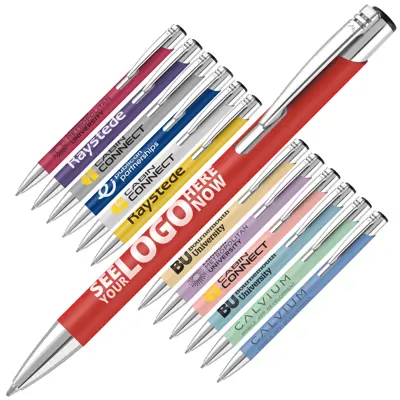
A branded pen used at a desk for six months is seen by its owner most working days and by anyone who borrows it. A tote bag carried on a commute is seen by everyone in the carriage. A branded notebook in a meeting is seen by everyone at the table. A cheap giveaway that goes in a bin at the end of an event is seen once.
Which produces the point that governs everything else: the cost of the item barely matters compared with whether it is kept. A cheap item that gets thrown away does not have a low cost per impression. It has an infinite one, because the denominator is zero.

A worked example, without the numbers
Take two orders of the same total value. One buys a large quantity of a low-cost item that most recipients discard within a week. The other buys a smaller quantity of something people keep and use daily for two years.
The first order generates a burst of impressions and then stops. The second generates fewer impressions on day one and carries on generating them every working day for two years, long after the invoice is forgotten.
Run the division at the end of that period and the second order usually wins comfortably, despite costing more per unit. That is the calculation to run before you order, and the honest input is not what the item costs. It is how long you genuinely believe the recipient will keep it.
The structural argument, which needs no research to make
Most marketing spend is priced per impression. You pay for the ad, the ad is shown, and when you stop paying it stops being shown.
Promotional merchandise is paid for once and delivers impressions for as long as the item survives. Nothing further is spent. A bottle bought two years ago is still working today at no additional cost.
That asymmetry is real and it does not depend on any study. It is also the reason the entire argument rests on retention rather than on price, and why the useful question at the ordering stage is "will they keep this" rather than "what does this cost".
Where merchandise genuinely works, and where it does not
Being straight about this is more useful than the alternative.
It works well for:
- Recall and staying present. An item in daily use keeps a brand in view between conversations, which is exactly the gap most marketing struggles to fill.
- Relationships and retention. A well-chosen gift to an existing client or an existing employee lands in a way an email does not.
- Events. Something to hand over is a reason to start a conversation, and something to take away extends it.
- Internal culture and belonging. Kit that a team actually wants to wear or use does something no internal comms email achieves.
It works poorly for:
- Cold lead generation. Merchandise given to people who have never heard of you rarely produces enquiries on its own. It supports a channel that generates the leads. It is not that channel.
- Anything needing precise attribution. See below.
- Rescuing a weak proposition. A branded item does not make an unconvincing offer convincing.
- Audiences who did not want the item. The wrong product to the right person generates nothing and can cost you a little goodwill.
If you are being asked to justify merchandise spend as a lead generation line, the honest position is that it is usually the wrong place to put it. It performs better on the retention and recall side of the budget, where the case is easier to make and truer.
Be sceptical of the statistics, including ours
You will find a lot of confident numbers about promotional merchandise: retention rates, recall percentages, returns on investment. We have deliberately not repeated any of them here.
Most originate from research commissioned by the promotional merchandise industry into the value of promotional merchandise. That does not make the findings wrong, and it does mean they should be read the way you would read any research funded by the people it benefits.
If you are relying on a figure to justify a budget, check four things: who funded the study, when it was carried out, how many people were surveyed, and whether the full methodology is published. If any of those is missing, do not put the number in a board paper.
Your own data is better than all of it, which is the next section.

How to actually measure it
Most merchandise spend is unmeasured, and that is a choice rather than a limitation. A few things make it measurable, and none of them is difficult.
Put a unique destination on the item
A dedicated short URL or a QR code that goes somewhere no other campaign points. Everything arriving through it came from the merchandise, and you can see it in your own analytics.
Use a code
A discount code, a reference code or a mention-this-code offer printed on the item. Redemptions are unambiguous.
Ask at the point of enquiry
Adding "how did you hear about us" to your enquiry form costs nothing and catches what analytics cannot.
Track the reorder
Whether an item gets reordered is the most honest signal you have. Nobody reorders merchandise that did nothing.
Set the comparison before you order, not after
Decide what would count as success while you still have the choice of not ordering. That single habit does more for merchandise ROI than any statistic.
And accept the limit
Some of what merchandise does is genuinely unattributable, in exactly the way brand advertising is. The right response is to measure the part you can and be honest about the part you cannot, rather than to invent a number for it.
Which products give the lowest cost per impression
Structurally, the products that do well share three characteristics: they are used often, they are used in front of other people, and they last.
That points towards bags, drinkware, clothing and anything that lives permanently on a desk, and away from single-use items and novelties. But the honest answer is that the best performer is the item your specific audience will actually keep, and that varies more by audience than by product category. A premium bottle is wasted on someone who already carries one. A notebook is wasted on someone who works entirely on a screen.
Our guide to choosing promotional products for an event covers how to work that out for a specific audience.