

What Drives the Price of a Printed Tote Bag
What sets the price of a printed tote bag: quantity breaks, fabric weight, print colours and sides, setup charges and delivery, and how to see your figure.

Related topics
View allFour things set the price of a printed tote bag: how many you order, which bag you choose, how the logo is printed, and which delivery option you pick. Quantity moves it more than the other three combined.
You don't have to ask us for a figure. Every tote bag on our site shows its price for the quantity and options you enter, so you can work through the choices below and watch the number move as you go.
Start with the quantity, because it's the biggest lever
Setting up a print run costs roughly the same whether you're printing 50 bags or 5,000.
The screens have to be made, the artwork has to be positioned, the press has to be set and a test print has to be checked. That work happens once. Spread across 50 bags it's a meaningful part of what you pay per bag. Spread across 5,000 it's almost nothing.
That's why the price per bag falls as the quantity rises, and it's why a small order will never reach the per unit price of a large one however you configure it.
The bit worth knowing. Prices step down at set quantity breaks rather than sliding smoothly. If your number sits just below a break, check the price at the next break up before you order. It's reasonably common to find that ordering a few more bags costs less in total, and you end up with spares.
The bag itself
Heavier fabric costs more. That's the main one.
Beyond weight, the things that move the price are the extras in how the bag is made. A gusset is more fabric and another seam. Long handles use more material than short ones. A dyed bag costs more than a natural one because it has been through an extra process. A certified organic or recycled bag carries the cost of the certification behind it.
Jute and canvas sit above standard cotton, and lighter value cotton sits below it.
Different styles of printed tote bags
View All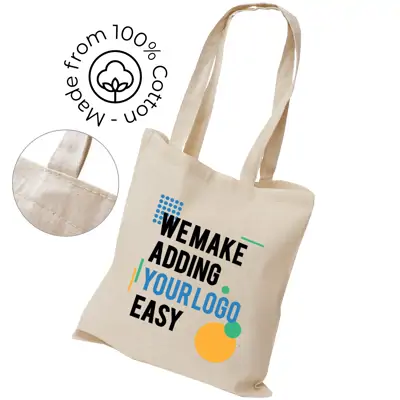
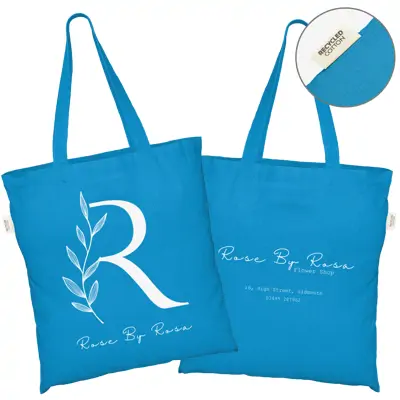
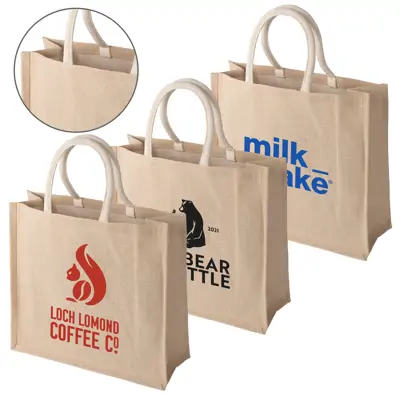
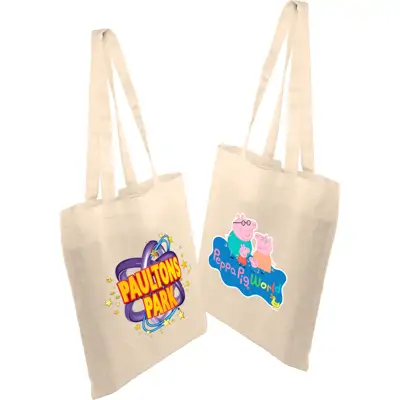
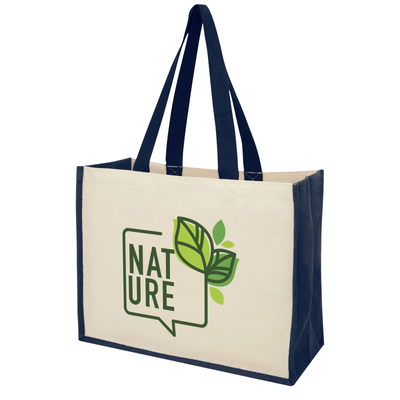
The print
Two things matter here, and only two: how many colours, and how many sides.
Colours. In screen printing, each colour is a separate screen and a separate pass through the press. One colour is the baseline. Two colours means twice the setup and twice the printing. Full colour printing works differently, applying the whole design in one process, and it's usually the better route for a logo with lots of colours or a photographic image.
Sides. Printing the back as well as the front means doing the whole job twice. It's worth it for retail bags and staff gifts, where the bag gets carried both ways round. For an exhibition giveaway, one side is usually enough.
Print size matters less than people expect. Going from a small logo to a large one on the same number of colours doesn't usually change much, because it's the same pass either way.
Setup and origination charges
These are the one off costs of getting your artwork ready to print, as opposed to the cost of printing it.
Depending on the method, that covers making the screens, colour matching the inks and setting the press. It's charged once per design rather than per bag, which is the reason the per unit price falls so sharply as quantity rises.
Two practical points follow from it. Reordering the same design later is usually cheaper than the first run, because that setup work has already been done. And splitting one order into two smaller ones will normally cost more than doing it in one, because you're paying to set up twice.

Artwork
The file you send affects both the price and the timeline.
A vector file is artwork built from lines and shapes rather than pixels, which means it can be scaled to any size without losing quality and can be separated cleanly into print colours. It's what a printer wants. Common vector formats are AI, EPS, PDF and SVG.
A JPEG or PNG pulled from a website is made of pixels. It can usually be worked with, and our in-house designers can often clean it up or redraw it as part of the Visual Proof process, but a vector file skips that step and gives the cleanest result at any size.
If you've a vector version of your logo, send that one.
Your delivery choice
Where a product supports it, you'll see a choice of delivery options in the basket, including Free No-Rush, Standard and Express, each with its own guaranteed date.
Faster costs more, which won't surprise you. The useful part is that you can see the price and the date for each option side by side before you decide, so the trade off is a choice you make rather than one you discover afterwards.
If your event is weeks away, No-Rush is the cheapest way to get there.
What doesn't change the price
Worth saying plainly, because these come up a lot.
A complicated logo in one colour costs the same as a simple one in one colour. It's the number of colours that matters, not how intricate the design is.
Asking for changes to your proof. Visual Proofs come with unlimited changes as part of the process, so getting it right doesn't cost you anything extra.
Requesting the proof in the first place. It's free, and you get the price with it.
How to get your exact figure in about a minute
Open the product page for the bag you're considering. Enter your quantity, choose your print options and the price updates as you go. Try the next quantity break up while you're there.
Then request a free Visual Proof™. Our in-house designers will put your logo on the bag and send it back with the price and the delivery date, usually in around 20 minutes. You can ask for as many changes as you need, and the price on your proof is held for 14 days, so there's time to get it signed off internally without the figure moving underneath you.
If you've been quoted less elsewhere for the same bag, the same specification and the same quantity, our Price Match covers qualifying like for like comparisons.