

Branded Power Banks and USB Sticks: What to Check Before You Order
Battery certification, what a power bank's capacity really delivers, USB-A against USB-C, and the security question...
Battery certification, what a power bank's capacity really delivers, USB-A against USB-C, and the security question worth asking first.


Related topics
View allBranded tech is the one merchandise category where the wrong choice can be more than a disappointment. A power bank carries a lithium battery, which brings certification and transport rules with it. A USB stick carries data, which brings a security conversation that plenty of organisations have already had.
Four things are worth checking before you order either: the certification, what the capacity figure actually delivers, the connector, and whether the people receiving them can use them at all.
Branded power banks
What the capacity figure really means
A power bank is sold on its milliamp hour rating, and that number is not the amount of charge it will put into a phone.
The cells inside a power bank run at a lower voltage than the USB output, so the charge has to be converted on the way out, and conversion loses energy as heat. The practical result is that the charge a power bank actually delivers is roughly two thirds of the number on the box. A little more on a good unit, a little less on a cheap one.
That is not a fault and it is not a supplier being misleading. It is physics, and every power bank on the market works the same way. It matters because a buyer comparing two products on the headline figure alone is comparing the wrong thing, and because anyone promising recipients "three full phone charges" from a rating that would suggest exactly three is going to be wrong.
The figure that tells you more is the output rating, which sets how fast it charges rather than how much it holds. A higher output charges a modern phone noticeably faster.
Popular Power Banks
View All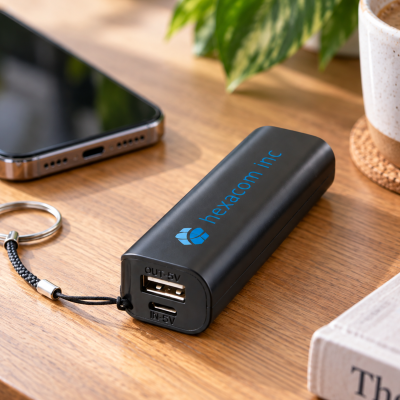



The certification to ask for
This is the part most buyers skip and it is the part worth doing.
UN38.3 is the transport safety test that every lithium battery has to pass before it can be shipped by air, sea or road. It covers altitude, temperature, vibration, shock and short circuit. A supplier who cannot produce the test summary for the product they are selling you is a supplier who cannot evidence that the goods are legal to ship.
UKCA or CE marking covers conformity with the relevant safety and electromagnetic standards. It should come with a declaration of conformity naming the product.
Protection circuitry should be built in, covering over-charge, over-discharge, over-current and short circuit. Reputable products have it and say so in the specification.
If this is important to you, the two questions to ask are, in these words: can you send me the UN38.3 test summary for this product, and can you send me the declaration of conformity. A supplier who supplies branded tech regularly will have both to hand.
Getting them to an event, and home again
Lithium batteries have to travel in cabin baggage rather than in the hold. That applies to your delegates as much as to you, so if you are handing out power banks at a conference where people are flying home, it is worth saying so when you give them out.
Watt hours are what airlines actually limit, and you work them out from the capacity and the voltage rather than from the capacity alone. Promotional power banks sit well below the threshold where airline approval becomes necessary, so this is a briefing point rather than a problem. Check the current airline guidance if you are shipping in quantity, because carriers set their own rules on top of the international ones.
Branding a power bank
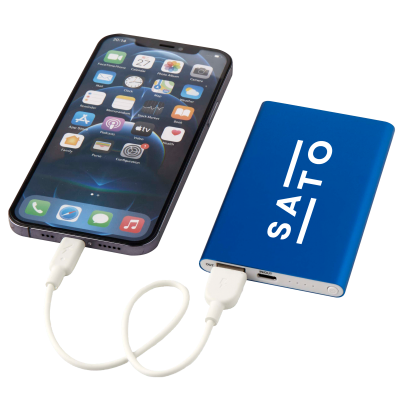
The casing is usually aluminium or plastic with one flat face, which is your print area. Aluminium takes laser engraving, which cannot wear off. Plastic takes pad printing or full colour print. Print areas on tech products are smaller than the product looks, because the surface has to stay clear of ports, buttons and indicator lights.
Browse the range on our branded power banks page.
Branded USB sticks
The question to settle first
Before choosing a drive, find out whether the people receiving it can use it.
Plenty of organisations now block USB ports on company machines as a standard security control, and in some sectors accepting an unsolicited USB stick is against policy. If you are giving them to a known audience, ask. If you are giving them out at an event to people you do not know, assume a proportion will not be able to use them.
That does not make USB sticks a bad choice. It makes them a good choice for some audiences and a poor one for others, and it is a five-minute question that saves an order. If the goal is getting a document into someone's hands rather than giving them a reusable item, a printed card with a short link or a QR code does that job without the security conversation.
USB-A or USB-C
Older drives use the rectangular USB-A connector. Newer laptops, tablets and phones increasingly have only the smaller USB-C ports.
A USB-A only drive will not plug into a lot of current hardware without an adapter, which most people will not have. If the drive is going to a mixed audience, a dual connector drive with one of each is the safer choice, and it is the reason that comparison is worth making before you order rather than after.
Branded USB Memory Sticks
View All


USB-A or USB-C
Older drives use the rectangular USB-A connector. Newer laptops, tablets and phones increasingly have only the smaller USB-C ports.
A USB-A only drive will not plug into a lot of current hardware without an adapter, which most people will not have. If the drive is going to a mixed audience, a dual connector drive with one of each is the safer choice, and it is the reason that comparison is worth making before you order rather than after.
Capacity, speed and where the cheap ones catch you out
Capacity is straightforward on a reputable drive. It is worth knowing that drives sold well below the going rate for their stated capacity are a known problem in low cost supply chains, where a smaller chip is configured to report a larger size and only fails once somebody tries to fill it. Buying from a supplier who can tell you the chip grade is the check that avoids it.
Speed is set by the USB generation. A USB 2.0 drive is fine for documents and slow for large files. A USB 3.0 or later drive is several times faster and matters if you are preloading video or large presentations.
Data preloading means the drive arrives with your content already on it. If you are using that, two things are worth doing: make the preloaded partition read-only where the supplier offers it, so your content cannot be overwritten by accident, and tell recipients what is on the drive rather than leaving them to find out. Both make the drive more likely to be plugged in.
Branding a USB stick
Plastic bodies take pad print or full colour digital print. Metal and wooden bodies take laser engraving, which is permanent and reads as the more considered option. Custom shaped drives are possible and carry longer lead times, since the body is tooled rather than picked from stock. Our guide to screen printing, embroidery and engraving covers the methods across every product.
Browse the range on our branded USB sticks page.
Choosing between the two
| Label | Power bank | USB stick |
|---|---|---|
| Best for | Conferences, long event days, premium gifting | Document handover, press kits, technical audiences |
| Perceived value | High, and it gets carried | Moderate, and falling as cloud sharing spreads |
| Main risk | Certification and transport rules | Recipients being unable or unwilling to plug it in |
| Branding | One flat face, engraving on aluminium | Body print or engraving, custom shapes available |
| Ask the supplier for | UN38.3 summary and declaration of conformity | Chip grade, connector type and preloading options |
If you are choosing one for a conference and the audience is mixed, a power bank is the safer choice, because everybody's phone runs down and nobody has to trust it with their data.
Minimums, cost and turnaround
Minimums on tech products are set per product rather than as a blanket policy, and they are usually higher than on simple giveaway items because each unit is an assembled electronic product. The number on the product page is the one that applies. If it is higher than you need, ask us, because there is often a comparable product with a lower one.
On cost, the drivers are the capacity, the build material, the connector and the branding method. Capacity moves the price most on both products. Custom shaped USB bodies and custom packaging both add lead time as well as cost, because something has to be tooled or made before anything can be printed.
Every product page shows its price at the quantity you enter, its minimum order and its guaranteed delivery date, before you speak to anyone. If you are buying tech as part of a wider conference order, our buying guide on budgets, quantities and lead times covers ordering across every category.